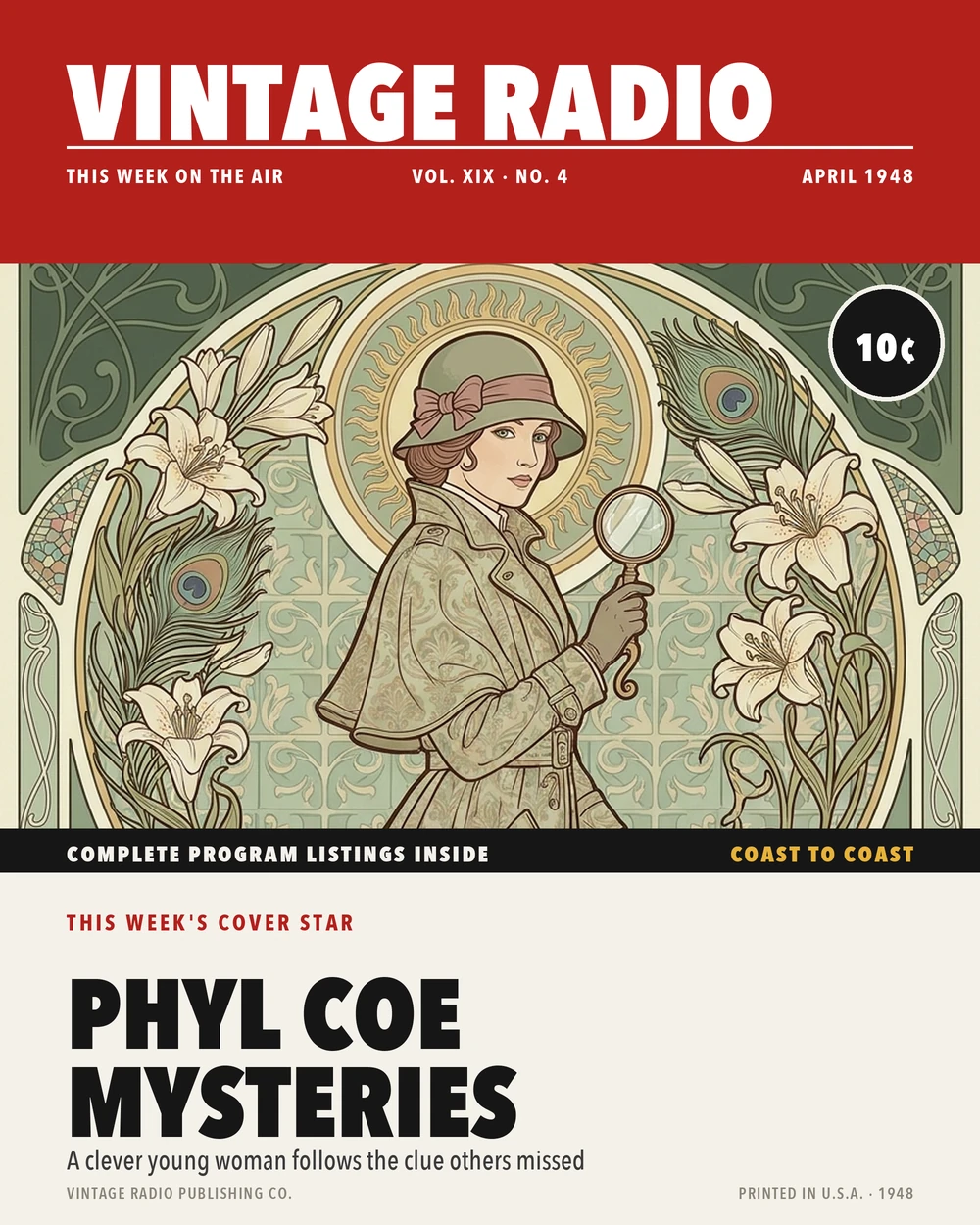
Phyl Coe Mysteries
The First Female Detective on American Radio
Long before the era of tough-talking radio private eyes became a genre staple, a show called Phyl Coe Mysteries put a woman in charge of the investigation. The series premiered on September 7, 1937, as a syndicated production sponsored by Philco Radio Tubes and distributed to roughly 250 radio stations across the country. OTR scholars have identified it as the first American radio series to feature a female detective in the lead role — a distinction that sets it apart from nearly everything else airing at the time, and makes it a genuine landmark in the history of the Mystery genre.
The connection between the show and its sponsor was built right into the title. Philco funded the series, and the character's name — Phyl, short for Phyllis — was chosen deliberately to echo the brand. It was a promotional calculation, but it worked, because the character herself was more than a marketing wrapper. Promotional materials described Phyl Coe as "the beautiful girl detective" — a smart, aggressive, take-charge private investigator with genuine investigative credentials in her backstory: her father, Phillip Coe, had been a world-famous criminologist, and Phyl had inherited both his instincts and his reputation to build on.
The Cast Behind Phyl
The role of Phyl Coe was played by actress Peggy Allenby, who brought enough authority to the part to sell the premise in a medium where voice was everything. Allenby later appeared on the television soap opera Edge of Night as Mattie Lane Grimsley, but her radio work here came years before that. Her Phyl was described as perceptive and quick-thinking — qualities the scripts required in every episode, since the mysteries moved fast and the plots didn't have room for a passive lead.
Playing Phyl's boyfriend and sidekick Tom Taylor was Clayton "Bud" Collyer, a name that would become much better known in later years. Collyer went on to voice Clark Kent and Superman on radio from 1940 to 1951, and after that built a second career as the host of television game shows Beat the Clock and To Tell the Truth. In 1937, though, he was the supporting player in a syndicated mystery series, feeding lines to radio's first female detective. The two performers together gave the show a dynamic that matched the premise: Phyl led the cases, Tom followed her reasoning.
How the Show Actually Worked
Phyl Coe Mysteries ran on a self-contained episode structure — each installment presented a complete mystery, with Phyl working the case from opening complication to apparent resolution. The production leaned hard on sound effects and voice acting as its primary storytelling tools, which was standard for the era, but the writing was noted for tight, well-paced plots and clear dialogue. Episode titles give a sense of the range: "Case of the Fallen Star," "Who Murdered Sen. Floyd," "Lauging Ghost," "Death Boards the Sea Serpent," "Death Ray Tube," "Case of the Dead Magician." The cases ranged from murder investigations to stolen property to the kind of pulp-inflected adventure the word "mystery" covered in 1930s popular fiction.
The show also worked in product placement in at least one episode, with a witness character heard listening to — and praising — a Philco radio set as part of the plot. That kind of integration was typical of sponsored radio, but the series went further with its central promotional mechanic, which was genuinely unusual.
The Listener Contest
The most distinctive structural feature of Phyl Coe Mysteries was that it withheld its solutions. The mysteries didn't resolve on air. Instead, listeners were directed to visit their local Philco dealer, pick up a booklet, record their own clues and proposed solution, and mail it in to the sponsor to compete for cash prizes. The contest was administered by Geare-Marston, Inc., of Philadelphia, and a total of $50,000 in prizes was reportedly awarded across all contest winners during the show's run.
This format tied the radio program directly to the retail network — every listener who wanted to enter a solution had to visit a Philco dealer — and it gave each episode a different kind of tension than most mystery radio offered. The audience wasn't just following Phyl to the answer; they were being asked to find it themselves. It's the kind of interactive format that was rare in any broadcast era, and it reflected how thoroughly the series was built around Philco's marketing goals, even as the mystery content operated on its own terms.
What Survives
The series originated as a Philco syndication, with sources pointing to 1936 as the starting point for distribution — well before the broadcast dates on the surviving recordings. All twelve episodes in circulation carry 1937 dates, running from the September 7 premiere through November 16. A thirteenth episode, "Jagged Rock Mystery," dated November 23, 1937, is documented in multiple research sources as program number twelve in the series, which places it just past the finale date on the surviving record. Whether it represents an additional episode beyond the twelve or a discrepancy in episode numbering remains an open question.
Paul Urbahns wrote about the series in "Phyl Coe Mysteries," published in the Metropolitan Washington Old Time Radio Club newsletter in August 2007, and the show has been discussed in OTR scholarship as part of the history of female representation in radio drama. The comparison to Nancy Drew has come up in that context — Phyl and the fictional teen sleuth were both amateur female investigators working in the same decade, operating in a broader cultural moment when women-led mystery narratives were finding audiences in print and on the air.
Why It Still Gets Attention
Eleven weeks on the air in the fall of 1937 is a short run by any measure, and Phyl Coe Mysteries left a small footprint in the historical record. But the combination of what it was — a female-led Mystery series, syndicated nationally before the major networks had fully standardized the genre, with an interactive format unlike anything else on the air — gives it a place in radio history that its brief run doesn't quite account for. Phyl Coe was a character built out of sponsor calculations, but Peggy Allenby played her as something more than a brand mascot, and the cases the writers gave her were constructed with enough care that the episodes hold together on their own terms. For a series that aired entirely within a ten-week window nearly ninety years ago, it made some choices that still feel worth noting.